
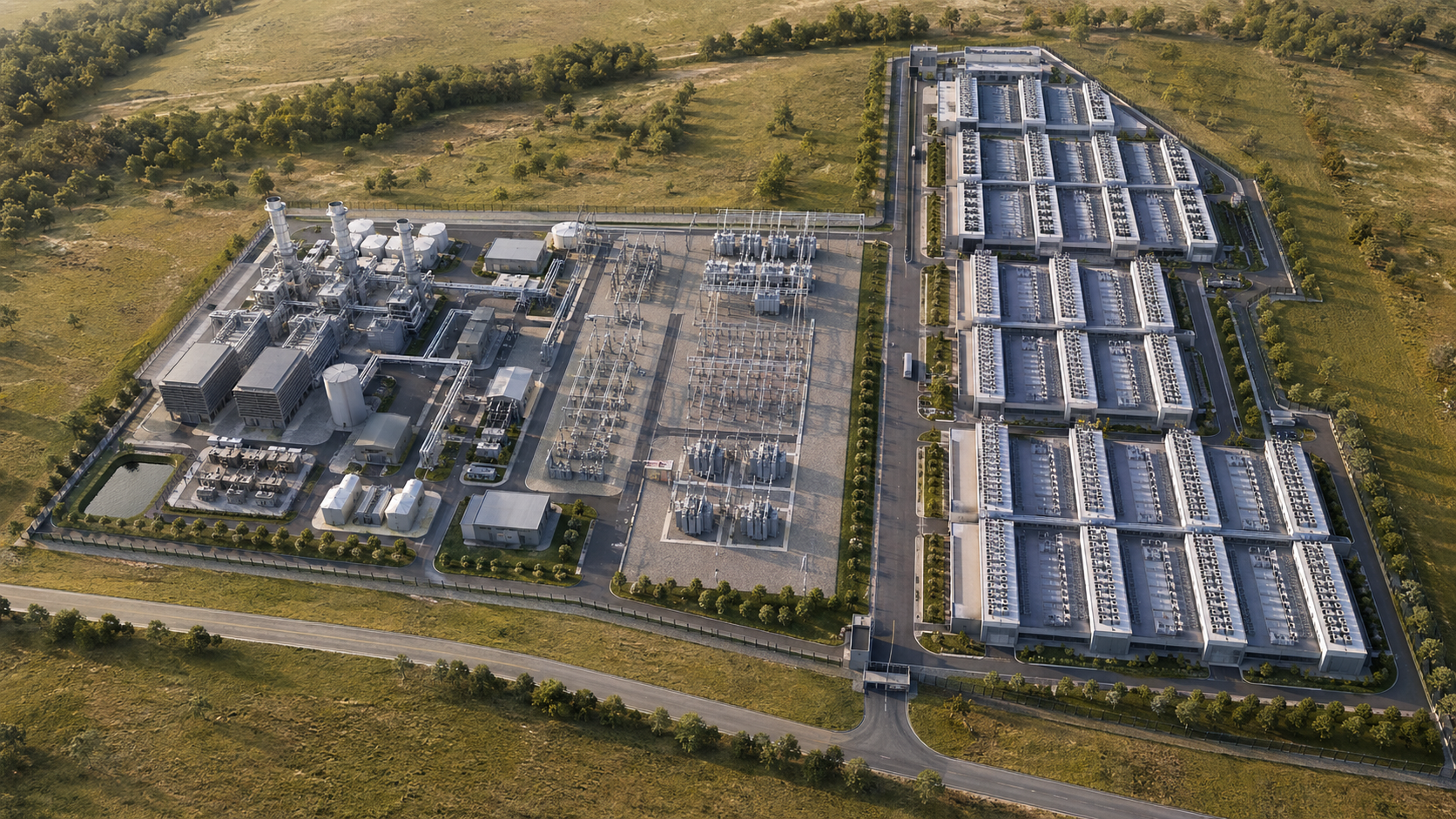
GridCore Campus Model
The Model for Modern Data Center Campuses.
GridCore is the repeatable framework for evaluating, planning, building, energizing, governing, and operating megawatt-scale data center campuses across multiple power strategies, deployment architectures, ownership models, and commercial structures.
Use GridCore to evaluate, structure, build, and operate data center campuses across multiple power strategies and deployment architectures — from utility-fed edge sites to grid-interactive campuses, self-generation campuses, powered land, powered shell, turnkey colocation, modular buildings, and high-density AI/HPC environments.
Power Strategy
Utility-fed, grid-interactive, self-generated, or islanded
Deployment Architecture
Container, modular building, building + skid, or campus-scale
Commercial Delivery
Powered land, powered shell, turnkey colocation, connectivity
Operations
Load release, safety, security, documentation, and lifecycle control
What GridCore Does
From Site Potential to Deliverable Compute Capacity.
GridCore converts land, power options, utility access, fuel strategy, fiber, building systems, modular infrastructure, safety requirements, and commercial demand into a structured campus model. Instead of treating energy, buildings, cooling, connectivity, security, and operations as separate projects, GridCore defines how they work together before commitments are made.
Evaluate the Site
Assess land, utility access, fuel availability, grid interconnection potential, fiber routes, permitting context, water constraints, workforce availability, physical security, expansion capacity, and customer demand.
Define the Power Strategy
Select the right power architecture for the project: utility-fed, grid-interactive, self-generation, islanded, or hybrid. GridCore treats power as a campus design decision, not a late-stage utility assumption.
Select the Deployment Architecture
Choose the physical infrastructure model: container-based zones, modular buildings, building + skid programs, purpose-built campus buildings, powered land, powered shell, or turnkey colocation.
Operate the Campus
Define load release, commissioning gates, safety programs, maintenance windows, tenant onboarding, access control, security operations, OT/IT boundaries, evidence records, and escalation authority before go-live.
Campus Architecture
One Campus Model. Multiple Implementation Paths.
GridCore is intentionally power-flexible and deployment-flexible. A GridCore campus can be utility-fed, grid-interactive, self-generated, islanded, or hybrid. What stays consistent is the integrated campus discipline: clear interfaces, governed operations, documented responsibility boundaries, and repeatable delivery.
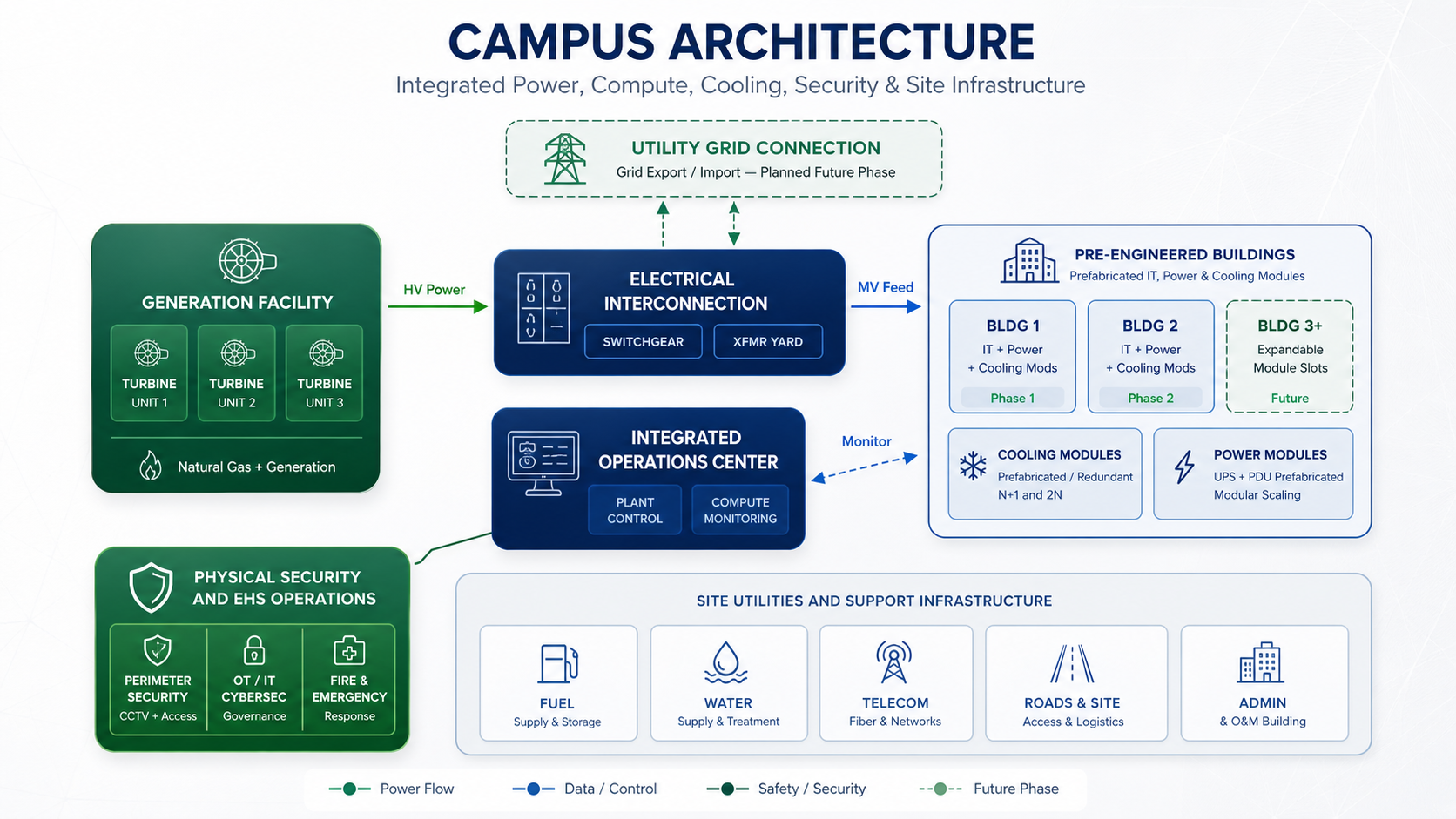
GridCore campus architecture overview. Final configuration, power strategy, capacity, redundancy, grid interface, equipment selection, phasing, and operating model are project-specific.
Power Strategy
Power Strategy Is a Design Variable, Not a Fixed Assumption.
Some campuses will be served primarily by the utility grid. Some will use utility service with onsite backup or supplemental generation. Some will use self-generation as prime power. GridCore provides a common framework for evaluating and integrating those power strategies into the campus design.
Utility-Fed Campus
For sites where utility capacity, delivery timeline, tariff structure, and redundancy profile support the intended load. GridCore still coordinates utility intake, campus distribution, metering, critical paths, and load release.
Grid-Interactive Campus
For sites that combine utility service with energy storage, generation, demand management, export capability, or market participation. GridCore treats the grid as both infrastructure interface and commercial variable.
Self-Generation Campus
For sites where onsite generation is used as primary or major supporting infrastructure. GridCore coordinates fuel, generation, plant controls, MV distribution, critical loads, cooling loads, tenant metering, and operating authority.
Islanded / Grid-Independent Campus
For campuses designed to operate without relying on continuous utility service. GridCore emphasizes generation reliability, redundancy, controls, black-start strategy, maintenance planning, load management, and staged load release.
Hybrid Energy Campus
For projects combining utility power, onsite generation, storage, renewable inputs, grid export, backup import, or other energy assets. GridCore provides the governance model for making those resources work as one campus system.
Explore All Power Strategies
See how GridCore approaches each power architecture in depth — design considerations, operating rules, and commercial implications.
View Power StrategyDeployment Architecture
Deployment Architectures from Edge to Hyperscale.
GridCore merges campus-scale planning with modular delivery. The same operating model can support compact edge deployments, modular capacity growth, pre-engineered buildings, building + skid infrastructure, and large multi-building campuses.
Fast, compact, repeatable
Container-Based
Containerized zones provide clear scope boundaries, accelerated deployment, and predictable replication across edge, remote, industrial, or initial-capacity use cases.
Flexible, phased, configurable
Modular Building
Modular buildings combine prefabricated assemblies with structured system integration for projects that require more configurability than containerized layouts while preserving repeatability.
High-capacity, repeatable, serviceable
Building + Skid
Pre-engineered building envelopes paired with repeatable power, cooling, IT, and controls skids support larger capacity programs with disciplined expansion.
AI/HPC and hyperscale ready
Purpose-Built Campus Building
Purpose-built buildings support high-density data halls, dedicated cooling architecture, dual-path distribution, meet-me rooms, security zoning, and long-term campus operations.
Customer-controlled facility
Powered Land
Customers build and operate their own facility inside a governed GridCore campus, with defined interfaces for power, fiber, access, security, utilities, logistics, and operating coordination.
Commissioned building platform
Powered Shell
The campus delivers a building shell and core infrastructure package, allowing customers to control IT fit-out while relying on structured campus power, cooling, connectivity, and operations interfaces.
Rack, cage, suite, or hall
Turnkey Colocation
The campus operator provides managed space, power, cooling, connectivity coordination, remote hands, monitoring, security, and tenant operations under a defined service framework.
Carrier-neutral campus network
Connectivity
GridCore defines carrier entry, meet-me rooms, inter-building fiber, cross-connects, tenant demarcation, network pathways, and OT/IT separation at campus scale.
Commercial Delivery
Commercial Structures That Match Infrastructure Reality.
GridCore supports multiple customer and partner relationships because modern campuses are not one-size-fits-all. GridCore defines the interfaces, service boundaries, documentation, and operating obligations needed to make those models executable.
Powered Land
Your facility. Campus infrastructure. A defined parcel with clear interfaces for power delivery, connectivity, access, security, and operating protocols.
Powered Shell
Commissioned building platform. Customer-controlled IT. Building shell and core infrastructure with power, cooling, and handover criteria defined.
Turnkey Colocation
Managed capacity for rack, cage, suite, hall, or building. Space, power, cooling, connectivity, remote hands, and tenant operations under a defined service framework.
Connectivity
Carrier-neutral campus network infrastructure. Carrier entry, meet-me rooms, cross-connects, dark fiber, and tenant demarcation.
Dedicated Campus
For large customers or strategic partners requiring substantial dedicated capacity, custom phasing, private operational boundaries, and long-term expansion rights.
Partner-Led Development
For development partners, landowners, energy providers, or capital partners structuring a GridCore campus program on qualified sites.
Integrated Systems
Every Critical System Designed as One Connected Architecture.
GridCore does not treat electrical, cooling, telecom, security, life safety, controls, and operations as independent packages. Each system is mapped to the campus architecture, deployment model, operating model, and commercial delivery structure.
Electrical Infrastructure
Medium-voltage intake, utility interface, generation interface, protection, metering, UPS, PDU, busway, RPP, rack-level distribution, redundancy options, and maintainability logic.
Thermal and Heat Rejection
Air cooling, liquid cooling, rear-door heat exchangers, dry coolers, pumps, water treatment, heat rejection, thermal buffer strategy, leak detection, and cooling load release.
Telecom and Data Distribution
Carrier entry, meet-me rooms, fiber pathways, inter-building routes, cross-connects, tenant demarcation, OT/IT separation, and network redundancy.
Fire, Life Safety, and Emergency Readiness
Detection, alarm integration, suppression approach, emergency access, evacuation logic, incident response, hazardous energy control, and readiness documentation.
Physical Security
Perimeter, gates, visitor processing, access control, CCTV, restricted zones, tenant areas, SOC workflows, credentialing, and security escalation.
Controls and Telemetry
Monitoring points, alarms, controls integration, operational dashboards, trend data, load behavior, maintenance evidence, and change-governed updates.
Delivery Lifecycle
From Diligence to Decades of Operation.
GridCore is not only a design language. It is a delivery discipline. The model supports development, engineering, procurement, construction, commissioning, load release, tenant onboarding, steady-state operations, and continuous improvement.
01
Evaluate
Site diligence, power strategy, deployment fit, stakeholder requirements, risk review, and commercial model selection.
02
Structure
Define offering model, customer interfaces, responsibility boundaries, procurement strategy, contract structure, and operating requirements.
03
Engineer
Coordinate electrical, mechanical, telecom, controls, safety, security, civil, building, and operations requirements under one design basis.
04
Build
Execute site work, utility/fuel interfaces, buildings, modular assemblies, skids, distribution infrastructure, fiber pathways, security systems, and support facilities.
05
Commission
Validate systems, complete readiness reviews, verify documentation, establish operating authority, and control staged load release.
06
Operate
Run the campus through governed maintenance, customer support, telemetry, incident response, compliance evidence, change management, and lifecycle improvement.
Why GridCore
The Risk Is in the Interfaces.
Large-scale compute infrastructure fails at the boundaries: between power and buildings, buildings and cooling, cooling and IT load, construction and operations, carriers and tenants, security and access, commercial promises and physical capability. GridCore reduces those gaps by defining the campus as one governed infrastructure platform.
GridCore and GridColo
GridCore Is the Model. GridColo Delivers It.
GridCore defines how a modern data center campus is planned, structured, powered, built, governed, and operated. It is a framework — not a brand or a colocation service.
GridColo is the operating company that delivers commercial services — colocation, powered land, powered shell, and campus connectivity — using the GridCore model. GridColo campuses are GridCore implementations.
Third parties — developers, operators, utilities, energy companies, or landowners — can also build and operate campuses using the GridCore model. GridCore does not require GridColo, and GridColo does not own GridCore.
GridCore
The FrameworkThe repeatable model for planning, structuring, powering, building, governing, and operating data center campuses. Applies to any operator, developer, or owner.
GridColo
The Operating CompanyThe commercial entity delivering colocation, powered land, powered shell, and connectivity services under the GridCore model. GridColo campuses are GridCore implementations.
Energy Compute Campus (ECC)
A GridCore Implementation PatternA named campus type within the GridCore model — a self-generation primary, islanded or grid-interactive campus designed for AI/HPC and high-density compute. ECC is one pattern. GridCore covers many.
Powered by GridColo
Third-Party ProgramFor campuses and operators that deliver services on GridCore-qualified infrastructure under the GridColo brand and operating standards.
What GridCore Is — and Is Not
Campus Framework. Not a Colocation Brand.
GridCore is not a colocation provider. It is not a construction company. It is the structured framework that determines how those functions relate to each other, where accountability sits, and how a campus is governed from first site plan through decades of operation.
GridCore IS the model
The repeatable framework: planning discipline, power strategy, deployment architecture, operations governance, safety structure, and commercial delivery logic.
GridCore IS NOT a colocation brand
GridColo is the colocation operator. GridCore is the underlying framework that GridColo — and others — implement.
GridCore IS power-flexible
No assumed utility dependency. Each site's power strategy is evaluated and designed per site conditions — utility, self-generation, islanded, or hybrid.
GridCore IS NOT a single campus
The ECC campus in Pittsburg, OK is one GridCore implementation. The model is designed to apply across many sites, geographies, and power contexts.
GridCore IS operator-agnostic
Developers, utilities, energy companies, landowners, and capital partners can apply the GridCore model to their own campus programs.
GridCore IS ownership-agnostic
Campus ownership, operator, investor, and customer relationships vary by project. GridCore defines how they interface — not who occupies each role.
Evaluate a Site Through the GridCore Model.
Whether you are developing a utility-fed campus, self-generated energy campus, powered land program, modular data center deployment, AI/HPC colocation facility, or grid-interactive infrastructure platform, GridCore provides the structure for turning site potential into deliverable compute capacity.